


If you are feeling confused by the mixed research and conflicting advice surrounding weighted clothing, you are not alone. Parents often hear conflicting information about whether these tools are safe or effective.
At OTogether, we want to help you cut through the noise. Today, we are diving into the science of why weighted vests work, the biological reason they often stop working, and how to use the “20-Minute Rule” to help your child thrive.
The OT Perspective: The Science of Deep Pressure
To understand how a weighted vest works, we first need to look at the proprioceptive system. Proprioception is the sensory system that receives signals from our muscles and joints, telling our brain where our body is in space.
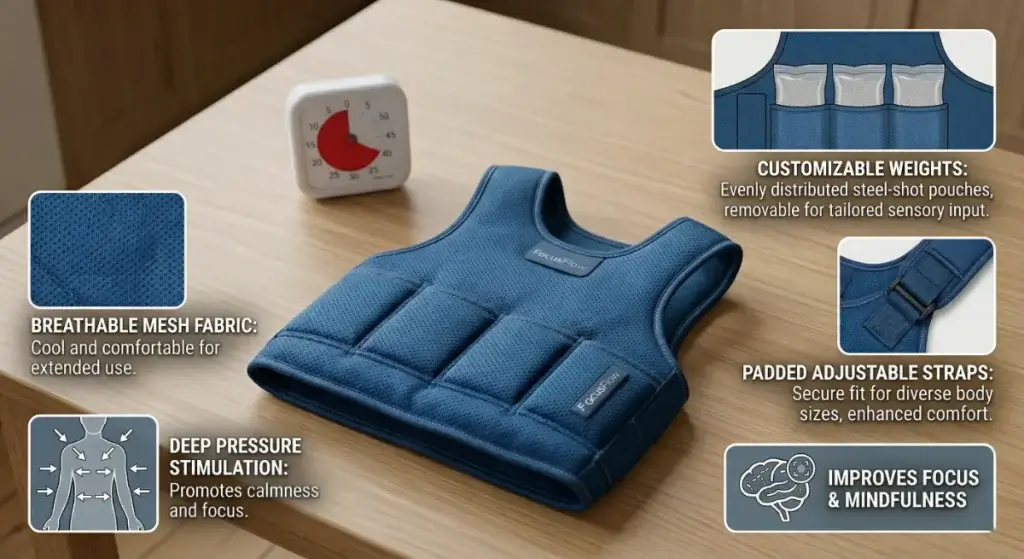
Weighted vests are designed to provide steady, even pressure across the torso, which delivers intense proprioceptive input. In the occupational therapy world, we refer to this as “deep pressure touch”.
When a child receives this deep pressure, it stimulates mechanoreceptors in their body that promote the release of serotonin (a calming chemical) and reduce the production of cortisol (a stress hormone).
This biological process actively calms the autonomic nervous system. For a child with Autism or ADHD who is experiencing sensory overload or struggling to self-regulate, this deep pressure acts like a firm, grounding hug. It helps them feel safe, reduces anxiety, and can decrease sensory-seeking behaviors like jumping, crashing, or fidgeting.
The Habituation Problem: Why “All Day” Doesn’t Work
If deep pressure is so calming, shouldn’t a child wear their weighted vest all day long? Absolutely not.
The human nervous system is incredibly efficient. When a new sensory input is introduced, the brain pays close attention to it. However, if that input remains constant, the brain quickly filters it out.
Think about what happens when you put a watch on your wrist: at first, you are acutely aware of the weight and the feeling of the band. But after about 20 minutes, your nervous system stops registering it, and you no longer notice you are wearing it.
The exact same phenomenon happens with weighted vests and compression garments. If your child wears a weighted vest for hours at a time, their nervous system experiences sensory adaptation (or habituation).
Their brain simply gets “used to” the extra weight, and the vest stops providing any calming benefits. Prolonged use not only renders the vest ineffective, but it can also cause discomfort or fatigue.
Key Takeaway: The “On/Off” Schedule and Safety Guidelines
To harness the true power of a weighted vest, it must be used as a targeted tool, not a daily uniform. Here is how to implement these tools safely and effectively at home or in the classroom.
1. The 20-Minute Rule
Because the nervous system habituates to the weight quickly, weighted vests should only be worn for short, purposeful intervals—typically 15 to 20 minutes at a time.
After 20 minutes, the vest must be removed to give the nervous system a break.
When you reintroduce the vest later in the day, the sensory input will be novel again, and your child will reap the calming benefits.
2. Strategic Timing
Use the 15-20 minute window strategically during times when your child needs the most grounding. Ideal times to use a weighted vest include:
- During circle time or tasks requiring a high level of body awareness.
- During focused, seated tasks like homework or classroom learning.
- Right before or during transitions that typically trigger dysregulation and anxiety.
3. The 5-10% Safety Rule
Safety is paramount when using weighted devices. An occupational therapist should always be consulted to ensure the vest is appropriate for your child.
The golden rule for safety is that the vest should weigh no more than 5% to 10% of your child’s total body weight.
For example, if your child weighs 50 pounds, the vest should only weigh between 2.5 and 5 pounds, and the weight must be evenly distributed to prevent postural issues.
Frequently Asked Questions
Do weighted vests actually help kids with ADHD?
Yes, many children with ADHD benefit from weighted vests. The consistent proprioceptive input helps organize the central nervous system, reducing the internal “noise” and allowing the child to improve their focus and decrease fidgeting during learning tasks.
Can my child wear a weighted vest to school?
Yes, a weighted vest can be an excellent accommodation in a classroom, but it requires coordination with the school. Some jurisdictions have specific legal guidelines or classify weighted items as physical restraints, so parental consent and an implementation plan (often integrated into an IEP or 504 plan) are essential.
Teachers must also be trained on the 15-20 minute “on/off” schedule to ensure it is used safely during active learning tasks.
Are there any children who shouldn’t use a weighted vest?
Yes. Weighted vests are not safe for children with certain respiratory issues, circulatory conditions, skin allergies, or significant physical impairments.
Furthermore, a child must be physically able to remove the vest themselves, and it should never be used against a child’s will or as a form of punishment.
Always consult your pediatrician or occupational therapist before introducing weighted garments.
The research on weighted vests seems mixed. Why is that?
Scientific research on weighted vests often shows mixed or inconclusive results regarding long-term behavioral changes.
Sensory processing is highly individualized, and it is very difficult to measure behavioral changes in a controlled research setting. While broad research may be mixed, clinical observation from occupational therapists and feedback from families consistently show that, when used properly with the 20-minute rule, these vests can provide immediate, powerful relief for an overwhelmed nervous system.
References
A Day in our Shoes. (n.d.). 50 Sensory Processing Accommodations In The Classroom.
Clinical Frontiers in Pediatric Sensory Processing: A Comprehensive Analysis of Neurobiological Mechanisms, Diagnostic Taxonomy, and Occupational Therapy Intervention Efficacy. New Patterns ABA. (2025, August 26).
Using Weighted Vests In Autism Educational Settings. Wood, V. (2025, September 16).
Weighted Vests and Compression Garments. The OT Toolbox.